One module. Several layers of MRI physics.
A single interactive scene brings together effects that are usually separated across different textbook chapters.
Spin & B₀
Alignment, population and precession set the physical starting state.
RF pulse
Excitation tilts magnetisation and creates the transverse signal.
Timing · TE / TR
Sequence timing links the mechanism to contrast and signal level.
Image & SNR
Reconstruction, noise and contrast define what the user finally sees.
Gradients & k-space
Encoding converts spatial position into sampled data and readout order.
Relaxation
T₁ recovery and T₂/T₂* decay reshape the signal over time.
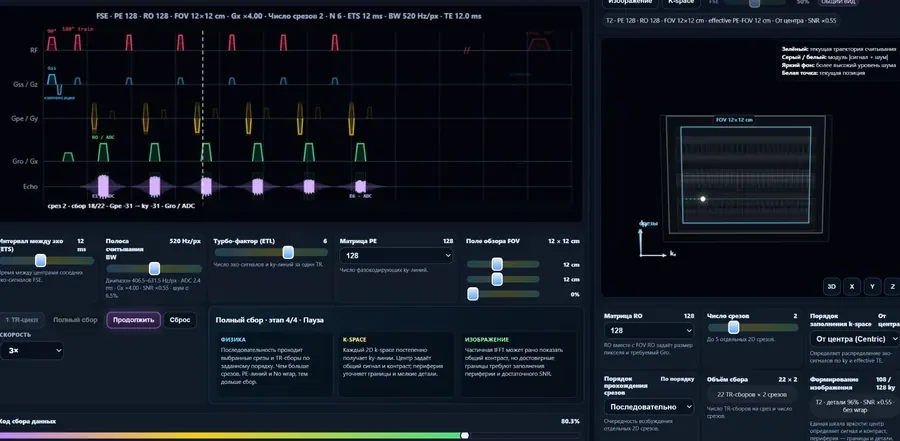 Interactive module
Inside one module, microphysics, vectors, timing, spatial encoding and image formation are shown as one connected system.